


Transforming the Online Sale of Healthcare Services — My Impact at Saúde iD
As a product designer at Saúde iD, my challenge was to transform the experience of purchasing healthcare services in a marketplace—creating a personalized and efficient user journey. I worked closely with the research and content teams.
Problem
Why weren’t exams selling?
Company context
Saúde iD, an early-stage startup from the Fleury Group, was created to democratize healthcare access in Brazil. As the first healthcare marketplace in the country, it offered consultations, surgeries, and exams at accessible prices.
Each service type had unique characteristics:
Consultations: Low average ticket (R$ 42), high sales volume, and potential to drive exam purchases
Surgeries: High average ticket (R$ 5,500), long decision cycle, and need for specialist support
Exams: Mid-range ticket (R$ 320), large supply volume, core business of the group—but zero sales
My role was to understand the scenario and propose solutions to change this reality.
Discoveries & Insights
I conducted an in-depth analysis of the market and the user journey, including:
Market research: Benchmarking similar players and studying health-service purchasing habits
User journey mapping: Identifying challenges and emotions from online search to offline lab visits
Vtex platform analysis: Understanding technological constraints
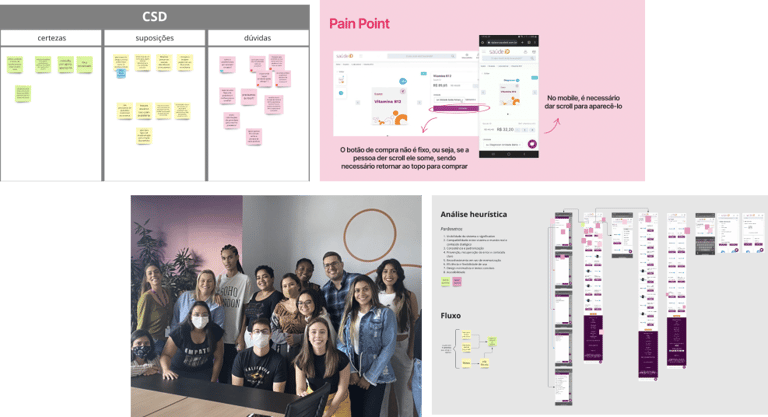
Main findings
💎 Humanized service as a differentiator: Customer service was the company's strong point.
💎 Healthcare services differ from product purchases: Users typically have a medical order, making the journey more objective
💎 Need for planning: Users must know exam date & time before purchasing
💎 Centralizing medical orders: Users prefer sending their request to speed up buying multiple exams
💎 Location as a deciding factor
Solutions implemented
Based on the insights, I implemented the following solutions:
Improved exam search
Enabled users to search and purchase multiple exams at once.
Smart medical request reader
Developed a feature allowing users to upload their medical order and automatically receive the list of necessary exams.
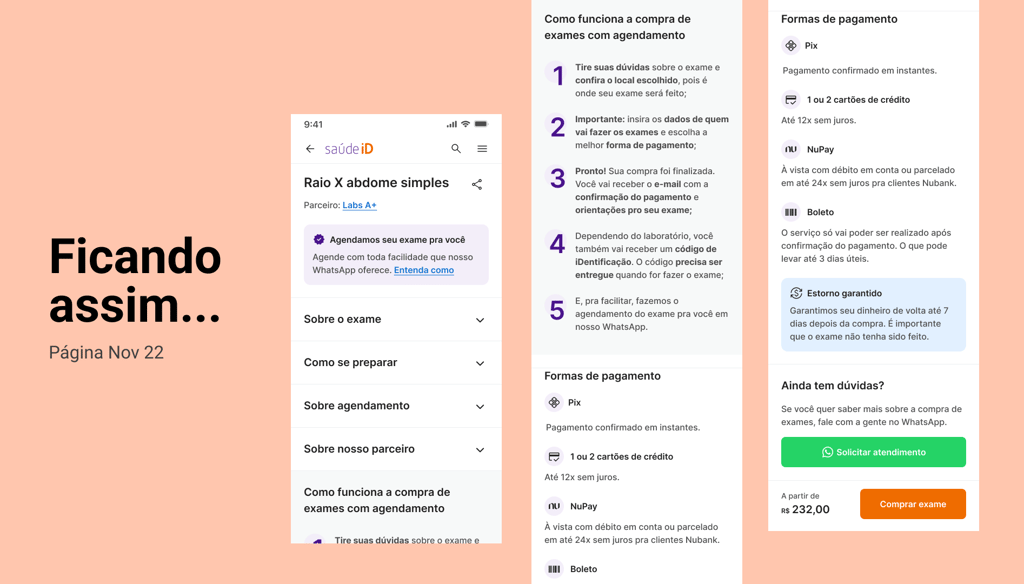
New exam page architecture
Restructured the page to prioritize clear, relevant information aligned with expectations.
WhatsApp as a sales channel
Tested WhatsApp as an alternative channel—resulting in significant sales volume.
Integrated scheduling
Added the ability to choose the date and time directly during the purchase flow.
The old version of the exam page before the changes, with tests carried out we were able to identify the improvements that were necessary in both the information architecture and usability of the page.
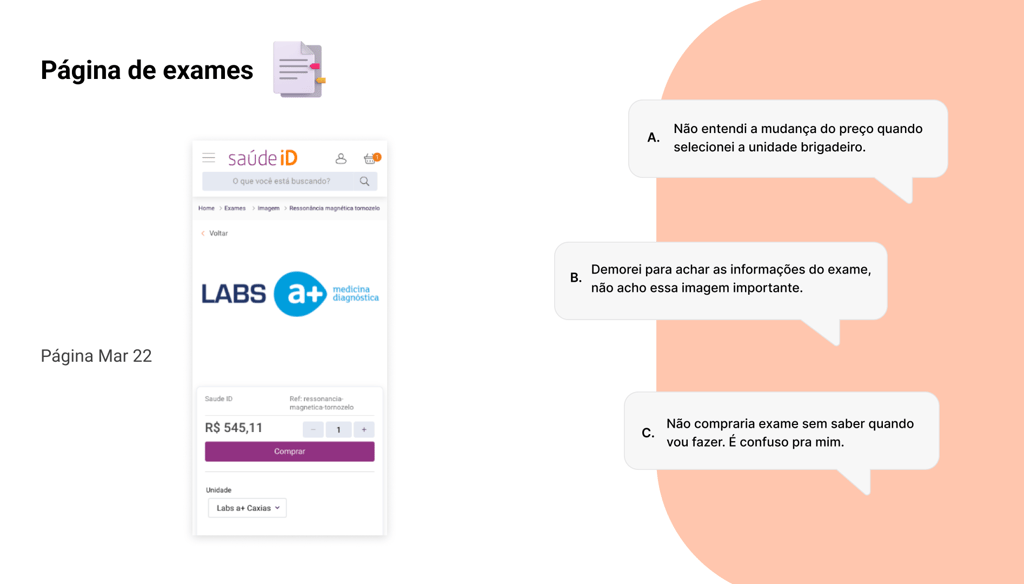
t was necessary to phase the changes, in the first phase I changed the information architecture, I carried out new tests again to continue evolving the page.
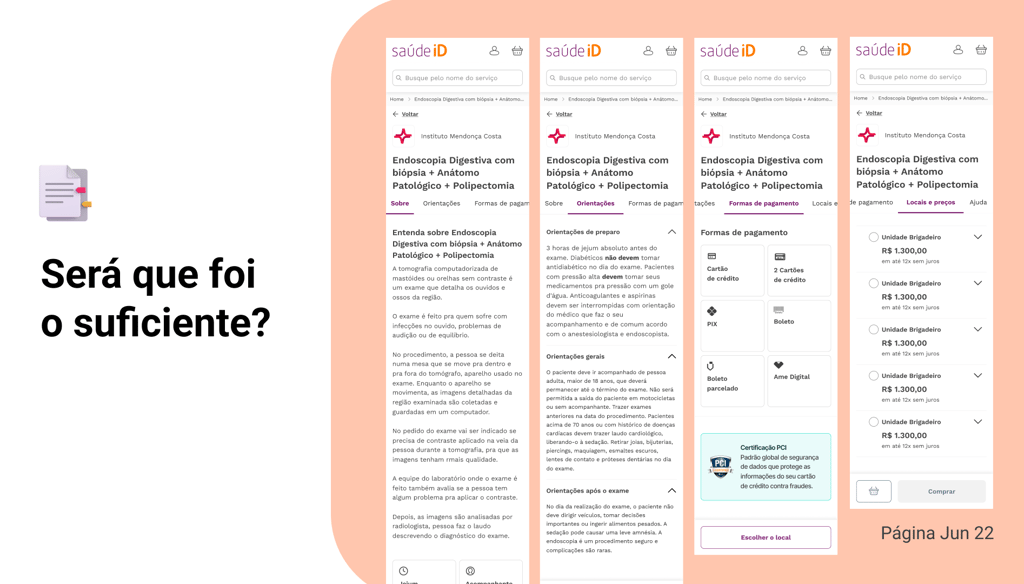
We implemented changes in phases due to Vtex limitations. Early iterations revealed that the platform prevented essential improvements. I convinced stakeholders to migrate away from Vtex, enabling more impactful enhancements and a better user experience.
Results & Impact
The results were clear and measurable:
Engagement: More users accessing exam pages and spending more time on them
Conversion: More clicks on the purchase CTA
Sales: From zero sales to an average of 20 exams sold per week
Strategic impact: Reduced friction and created a scalable model for exam sales
Reflections & Learnings
This project taught me the importance of tailoring digital solutions to the specific needs of the healthcare industry—where sensitivity and practicality are essential. Iterative research and collaboration with stakeholders were key to the success. Migrating from Vtex enabled us to implement critical improvements and build a more efficient, user-centric experience.
